
集佳合伙人趙雷文章在歐洲商標協會(ECTA)年會會刊 ECTA Daily 發表
2017-07-03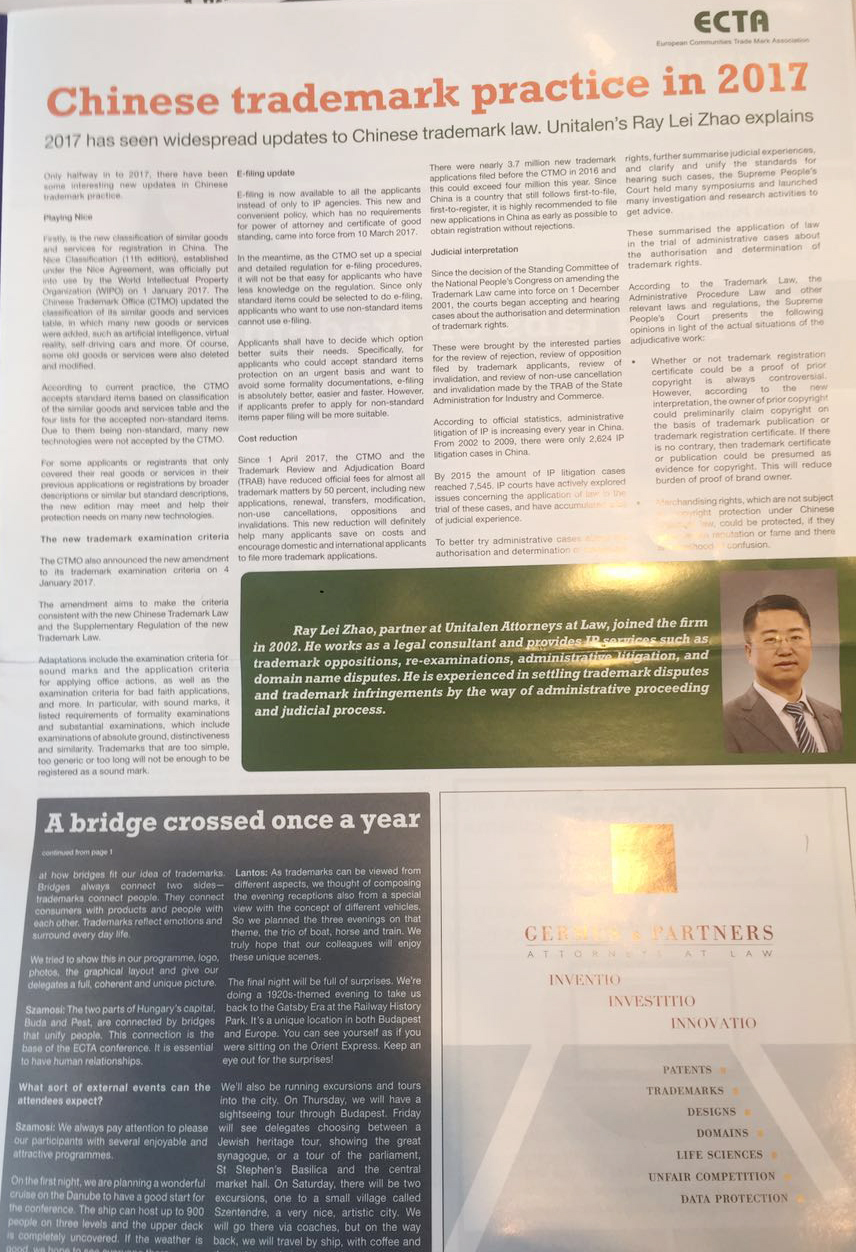
Chinese trademark practice in 2017
2017 has been widespread updates to Chinese trademark law. Unitalen’s Ray Lei Zhao explains
Only halfway in to 2017, there have been some interesting new updates in Chinese trademark practice.
Playing Nice
Firstly, is the new classification of similar goods and services for registration in China. The Nice classification (11th edition), established under the Nice Agreement, was officially put into use by the World Intellectual Property Organization (WIPO) on 1 January 2017. The Chinese Trademark Office (CTMO) updated the classification of its similar goods and services table, in which many new goods or services were added, such as artificial intelligent, virtual reality, self-driving cars and more. Of course, some old goods or services were also deleted and modified.
According to current practice, the CTMO accepts standard items based on classification of the similar goods and services table and the four lists for the accepted non-standard items. Due to them being non-standard, many new technologies were not accepted by the CTMO.
For some applicants or registrants that only covered their real goods or services in their previous applications or registrations by broader descriptions or similar but standard descriptions, the new edition may meet and help their protection needs on many new technologies.
The new trademark examination Criteria
The CTMO also announced the new amendment to its trademark examination criteria on 4 January 2017.
The amendment aims to make the criteria consistent with the new Chinese Trademark Law and the Supplementary Regulation of the new Trademark Law.
Adaptations include the examination criteria for sound marks and the application criteria for applying office actions, as well as the examination criteria for bad faith applications, and more. In particular, with sound marks, it listed requirements of formality examinations and substantial examinations, which include examinations of absolute ground, distinctiveness and similarity. Trademarks that are too simple, too generic or too long will not be enough to be registered as a sound mark.
E-filing update
E-filing is now available to all the applicants instead of only to IP agencies. This new convenient policy, which has no requirements for power of attorney and certificate of good standing, came into force from March 10 of 2017.
In the meantime, as the CTMO set up a special and detailed regulation for e-filing procedures, it will not be easy for applicants who have less knowledge on the regulation. Since only standard items could be selected to do e-filing, applicants who want to use non-standard items cannot use e-filing.
Applicants shall have to decide which option better suits their needs. Specifically, for applicants who could accept standard items protection on an urgent basis and want to avoid some formality documentations, e-filing is absolutely better, easier and faster. However, if applicants prefer to apply for non-standard items paper-filing will be more suitable.
Costs reduction
Since 1 April 2017, the CTMO and the Trademark Review and Adjudication Board (TRAB) have reduced official fees for almost all trademark matters by 50 percent, including new applications, renewal, transfers, modification, non-use cancellation, opposition and invalidation. This new reduction will definitely help many applicants save on costs and encourage domestic and international applicants to file more trademark applications.
There was nearly 3.7 million new trademark applications filed before the CTMO in 2016 and this could exceed four million this year. Since China is a country that still follows first-to-file, first-to-register”, it is highly recommended to file new applications in China as early as possible to obtain registration without rejections.
Judicial interpretation
Since the dcision of the Standing Committee of the National People's Congress on aending the Trademark Law came into force on 1 December 2001, the courts began accepting and hearing cases about the authorisation and determination of trademark rights.
These were brought by the interested parties for the review of rejection, review of opposition filed by trademark applicants, review of invalidation and review of non-use cancellation and invalidation made by the TRAB of the State Administration for Industry and Commerce.
According to official statistic, administrative litigation of IP is increasing every year in China. From 2002 to 2009, there were only 2,624 IP litigation cases in China.
By 2015, the amount of IP litigation cases reached 7,545. IP courts have actively explored issues concerning the application of law in the trial of these cases, and have accumulated a lot of judicial experience.
To better try administrative cases about the authorisation and determination of trademark rights, further summarise judicial experiences, and clarify and unify the standards for hearing such cases, the Supreme People's Court held many symposiums and launched many investigation and research activities to get advice.
These summarised the application of law in the trial of administrative cases about the authorisation and determination of trademark rights.
According to the Trademark Law and other relevant laws and regulations, the Supreme People's Court presents the following opinions in light of the actual situations of the adjudicative work:
Whether or not trademark registration certificate could be a proof of prior copyright is always controversial. However, according to the new interpretation, the owner of prior copyright could preliminarily claim copyright on the basis of trademark publication or trademark registration certificate. If there is no contrary, then trademark certificate or publication could be presumed as evidence for copyright. This will reduce burden of proof of brand owner.
Merchandising rights, which are not subject to copyright protection under Chinese copyright law, could be protected, if they have certain reputation or fame and there is a likelihood of confusion.
相關關鍵詞
公司總部
機構代碼:11227
地址:北京市朝陽區建國門外大街22號賽特廣場七層
郵編:100004
總部電話:(8610)59208888
電子郵箱:mail@unitalen.com
郵件新聞接收
不要錯過我們提供的中國區知識產權保護的相關信息、服務和活動通知
提交將接受我們特別的服務優惠和知識產權保護咨詢的電子郵件




法律聲明 Unitalen Mail Box ?2016 Unitalen Attorneys at Law 版權所有 集佳知識產權代理有限公司 京ICP備11033076號 京公網安備11010502020670